Imperial Moth

Imperial Moths (Eacles imperialis) in the family Saturniidae are large silk moths commonly found in forested areas throughout Missouri. They are also often found in suburban areas, especially near lights at night. The biggest one I ever found was at a gas station/convenient mart on the outskirts of St. Joseph.
Their range includes most of the Eastern United States from Nebraska to Maine. There are some reports that they are declining at an alarming rate in the northeastern part of their range. The population decline in these locations could and probably is due to habitat loss. Throughout the rest of their range their numbers are secure to abundant. The adults are large with wingspans up to 5.5 inches and are yellow with variable lavender spots. Males are smaller than females.

These large moths do not feed as adults, instead they get all the nutrition they need as caterpillars. If you've never seen one of these in their larval form, it is truly impressive. When hatched they are barely visible and possess an incredible appetite. They feed voraciously and reach lengths up to 3 or 4 inches when ready to pupate. They manage this in the span of several weeks.  It has been said that if a human baby gained weight like a caterpillar, they would weigh as much as a hippo in a single weekend. They feed on a wide variety of tree species like oak, hickory, walnut, pine, maple (including box elder), Norway spruce, sassafras, sweet gum and many others.

Moths are covered in furry scales that protect them from cooler nighttime temperatures. These large moths take it to a whole new level with what appears to be a winter-weight coat, complete with scarf and leg warmers. After midnight the females will begin signalling for males by emitting a pheromone. The males are capable of "smelling" the females from distances of more than a mile. He uses his large, feathery antennae to home in on her scent. Females will lay eggs one at a time, or up to 2 to 5 on the leaves of host plants. Eggs hatch in a couple of weeks. When ready to pupate they will move to the base of the host tree and burrow into the ground to pupate for the winter.

Naturalist Gene Stratton Porter wrote about the Imperial Moth in her novel "A Girl of the Limberlost" It was a prominent character in the plot development of the novel. She had a life long love of silk moths and shared her passion for their beauty in the book Moths of the Limberlost.


Make that Goera fuscula: my mistake


When I was at the point of posting yesterday's entry I had second thoughts and almost hit "delete" instead of "publish."  I should have.  After closer study this morning, I've determined that the Goerids I found yesterday were, species, Goera fuscula, not Goera calcarata.

The thing that bothered me yesterday -- that drove me to look at these insects again -- was the size. The larva that I examined was 11 mm: Beaty has "8-9 mm" for G. calcarata, but "9-11mm" for G. fuscula.  So let's have a look at Beaty's description of G. fuscula.

G. fuscula -- larvae 9-11 mm; 4 pairs of sclerites on metanotum; sternal thoracic plates distinct; face with central area smooth; posterior carina sharp and high.  Mountains only. Rare with less that 15 BAU records.  (Beaty, "The Trichoptera of North Carolina," p. 87)

1.  As I've already noted, the larva that I pulled from its case and measured was 11 mm; the case was 12 mm.

2. There are indeed 4 pairs of sclerites on the metanotum, not 3!  If you look directly down on the dorsum of the metanotum you'll only see three, but if you turn the larva on its side, you'll then see the 4th.  (Sclerites are bounded, dark spots on the fleshy body, normally containing setae.)


3. And yes, the sternal thoracic plates are distinct.  That's the first thing I noted this morning.  That on its own eliminates G. calcarata for the ID.


4. Head/face -- it's flat, almost depressed, surrounded by a quite clear carina.


Another look at the carina and head/face in a photo from my friend in Sugar Hollow.


Goera fuscula.  The tolerance value remains undetermined since it's an uncommon species.

________________

One other point of interest on Goera in general.  On Friday, when my friend and I went to that small stream in Sugar Hollow, she saw some cases that looked like Goera.  They appeared to be sealed off for pupation, but she took them home for a look.  After a time, the larvae emerged -- the cases weren't sealed off at all!

The same thing happened to me yesterday.  Here's what I saw.


I was initially disappointed since I knew by the cases that these were Goerids: but then they emerged.


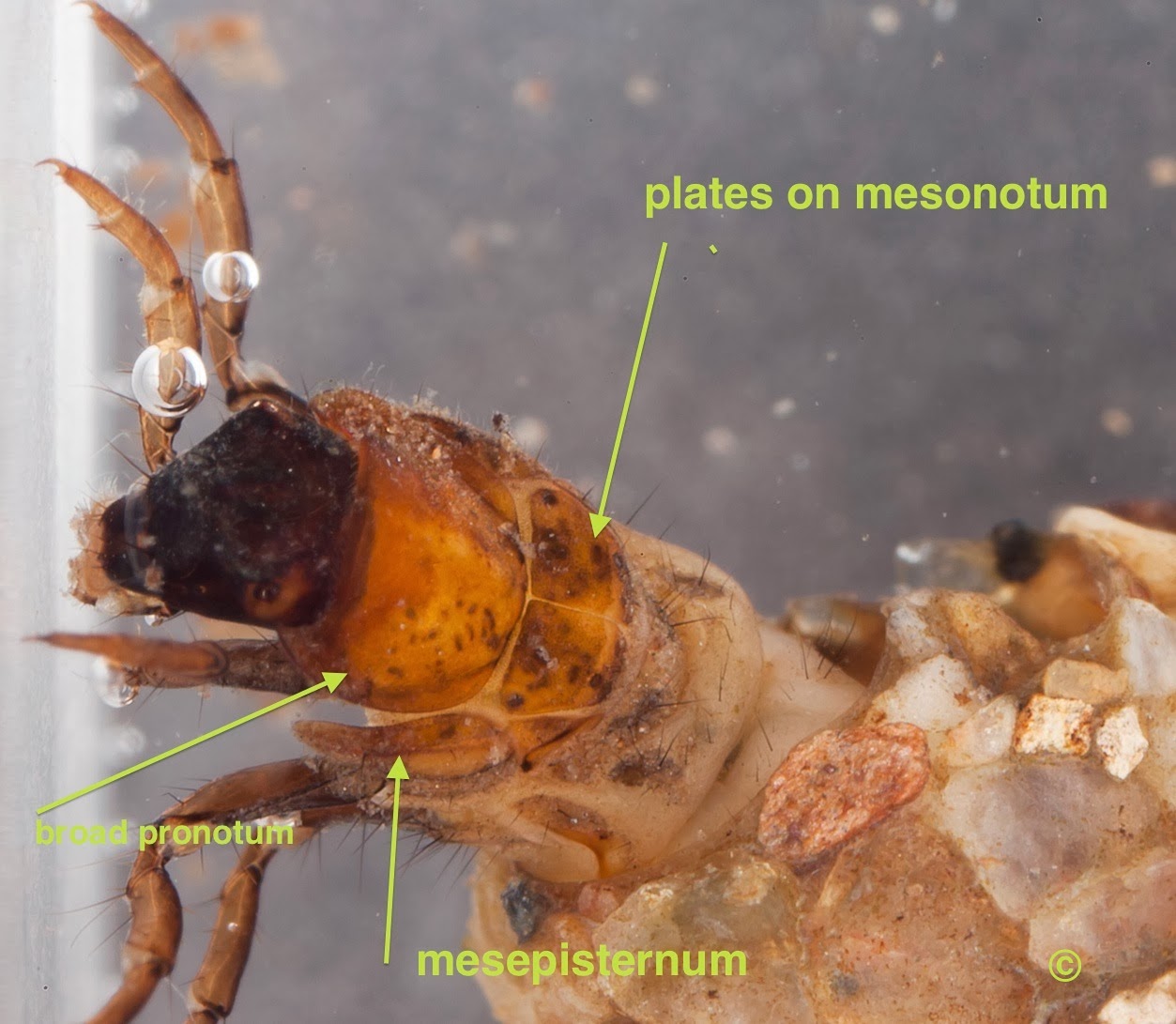
When I was reading Glenn Wiggins (Larvae of the North American Caddisfly Genera, 2nd edition, 1996) on the Goerids, I discovered that this is characteristic of the Goerids.  Look at this photo from my friend's collection, then I'll quote from his book.


"Larvae of the Goeridae are characterized by major modifications to the thoracic nota.  The pronotum is enlarged and thickened laterally; sclerotized plates of the mesonotum are subdivided into two or three pairs of smaller sclerites, and the mesepisternum is extended anterad as a prominent process.  These modifications are integrated to form a set of close-fitting sclerites forming an operculum that closes off the anterior opening of the case when the larva withdraws."(Wiggins, p. 226)

So, if you find one of these cases and it appears to be sealed -- don't be too sure!

Goeridae -- the "Weighted-case Maker" -- at South River: Goera calcarata


(Please read the next entry.  This ID was wrong.  The larvae I found were G. fuscula.)

I've been waiting a long time to see this one -- but it's not really that photogenic!  This is the first Goerid (Weighted-case maker) I've seen, and I had to go to the South River (Greene County) to find it, that despite the fact that my friend has found them in a regular way in the small streams in Sugar Hollow.

At first glance, Goerids look a lot like Uenoids, but one of the ways in which they differ is in the design of the case.  "Case: Similar to that of Neophylax [Uenoid] but with a continuous row of larger ballast stones laterally, usually two."  (Beaty, "The Trichoptera of North Carolina," p. 87)  Uenoids typically have 3 stones on each side of the case, in some cases 4.


But what really sets the Goerid apart is the pronotum: "pronotum produced anterolaterally into wide, sharply pointed processes."  (Beaty, p. 87)  This is the best I could do in a live view.


They're easier to see in this microscope view as is the pointed nature of the head.


Another view  -- live view -- of the pronotal and mesonotal projections taken by my friend in Sugar Hollow.


According to Ames (Caddisflies, p. 232) the most common Weighted-case maker we see is Goera calcarata, and that's the species I found.   Beaty describes G. calcarata in the following way:

G. calcarata -- larvae 8-9 mm; 3 pairs of sclerites on metanotum; pronotum with central raised area the anterior margin with conspicuous spicules; sternal thoracic plates indistinct.  Common in the Mountains and Sandhills.  In North Carolina, G. calcarata is given a TV of 1.0.

Of the features noted by Beaty, the "3 pairs of sclerites on the metanotum" were very clear.


I could see the raised area on the prontum, but my photo is not very good.


I could not see any plates on the thorax.  But in the end, the metanotal sclerites will do to establish the identification since the other species that are found in NC (G. fuscula and G. stylata) both have 4 pairs of sclerites, not 3.   This larva was 11 mm.

Goera is known to fly fishermen as the "Little gray sedge," and according to Ames (p. 232) "They appear through June in the mid-South and into August in the Adirondacks and New England."

Nice to finally add this to my list.

________________

Other photos:

1. Odontocerids (Strong-case makers) -- Psilotreta labida.  They were easy to spot on the rocks.


2. A pretty, small minnow mayfly -- Acentrella turbida.  Fully mature.


3. And -- finally -- the first small winter stoneflies of the new season.


Not much to look at at this stage of the game.
________________

All Goerids were found in Entry Run, a tributary of South River.